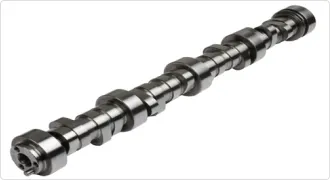
The cams and camshaft provide actuation for the valve motion in concert with the motion of the pistons and crankshaft, usually by a drive connection to the crankshaft, through direct gearing, chains, or belt drives, which assures mechanical synchronicity.Camshafts with integral cam lobes may be formed from white or chilled cast iron or forged steel.
Crankshaft - 38MnSiVS5, 41Cr4, EN19, SAE1541B
Camshaft - S48C, SAE1541
Gears are rotating machine elements that transmit torque from one shaft to another via the teeth machined into them. Gears with similar tooth profiles mesh. This allows transmitting the power from a driving shaft to a driven one.
Power transmission, or a gearbox, acts as the medium that transmits power generated by the engine to the wheels via a mechanical system of gears and gear trains.
A transmission allows a person to apply power to a vehicle in a controlled manner, without which, the car would not efficiently move
Gears & Shafts - SCM420H, SCM415H, 16MnCr5, SAE4140, 20MnCr5
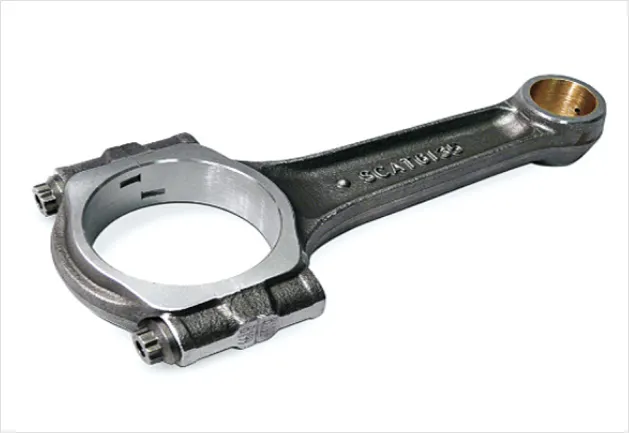
A connecting rod, also called a 'con rod', is the part of a piston engine which connects the piston to the crankshaft.
Together with the crank, the connecting rod converts the reciprocating motion of the piston into the rotation of the crankshaft.
The connecting rod is required to transmit the compressive and tensile forces from the piston. In its most common form, in an internal combustion engine, it allows pivoting on the piston end and rotation on the shaft end.
Connecting Rods - C70S6, 36MnVS4, 44MnSiVS6
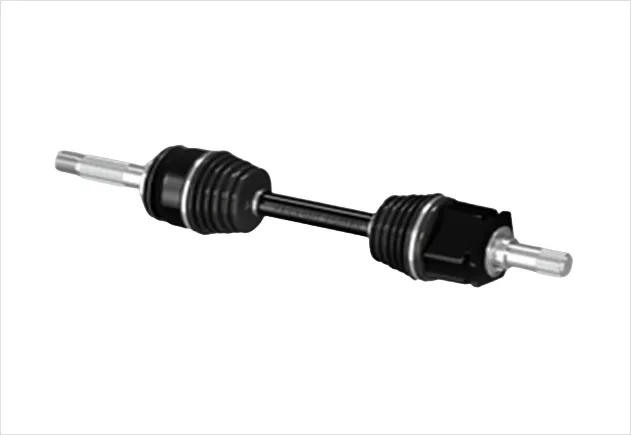
An automobile may use a longitudinal shaft to deliver power from an engine/transmission to the other end of the vehicle before it goes to the wheels. A pair of short drive shafts is commonly used to send power from a central differential, transmission, or transaxle to the wheels.
An axle is a rod or shaft that rotates the wheels and supports the weight of your vehicle. Axles are essential components of any vehicle and come in three main types: front, rear, and stub.
The axle beam plays a significant role in the assembly of car wheels. The design and manufacturing quality of the axle beam have a significant impact on the suspension performance and driving stability of the vehicle.
A front axle beam is a crucial part of a vehicle's suspension system. It connects the front wheels to the chassis and provides support and stability to the front end of the vehicle.
Axle Shaft - SAE 1541, 15B41
Drive Shaft - SAE 1050M, 38B3
Axle Beam - 40Cr4C, 42CrMo3
Bearings are mechanical components that support the shaft that rotates inside machinery. They facilitate smooth motion and support axial and radial loads.
Bearings are spherical units that accomplish the same objective as a roller bearing. They are circular joints that connect a rotating part to another, usually stationary, part of a machine. Bearings reduce friction by converting surface friction to rolling friction.
Ball Bearings are the most common type of bearing and are commonly used in electric motors, household appliances, car motors, office machinery, automation control, and garden and household tools.
Most Bearings are made from a type of steel called high carbon chromium steel, also known as chrome steel/bearing steel. This material is durable and cost-effective
Bearings - 100Cr6, SUJ2, SAE 52100
A leaf spring is a simple form of spring commonly used for suspension in wheeled vehicles.
Originally called a laminated or carriage spring, and sometimes referred to as a semi-elliptical spring, elliptical spring, or cart spring, it is one of the oldest forms of vehicle suspension.
A leaf spring is one or more narrow, arc-shaped, thin plates that are attached to the axle and chassis in a way that allows the leaf spring to flex vertically in response to irregularities in the road surface.
Laminated/Parabolic leaf springs are the most used arrangement, running the length of the vehicle and mounted perpendicular to the wheel axle, but numerous examples of transverse leaf springs exist as well.
A coil spring absorbs the vibrations and bumps from the road, this makes driving much smoother. The coil spring is a key component of a vehicle's suspension system and is designed to absorb shock.
These steels are generally low-alloy manganese, medium-carbon steel or high-carbon steel with a very high yield strength.
Suspension - 51CrMoV4, 50CrV4
A stabilizer bar is an automobile suspension part that helps to reduce the body roll of a vehicle during fast cornering or over road irregularities. It links opposite front or rear wheels to a torsion spring using short lever arms for anchors.
Stabilizer bars are made from steels with higher tensile strength. The material properties and metallurgical processes are important for vehicle elements.
Stabilizer Bars - SUP9, SUP11, 51CrV4
High-tensile fasteners are steel fasteners that can withstand high levels of pressure and tension. They are used in almost every part of wind turbines, including tower sections, nacelles, and rotor blades. High-tensile fasteners are designed to be strong and reliable in situations where standard fasteners might fail.
High-tensile fasteners are made from alloy steel and can withstand high levels of mechanical stress and loading.
Wheel nuts are threaded fasteners that are semi-permanently mounted directly to the vehicle hub, usually through the brake drum or brake disk. They are fastened onto the wheel stud to secure the wheel.
High Tensile Fasteners - 42CrMo4 QT
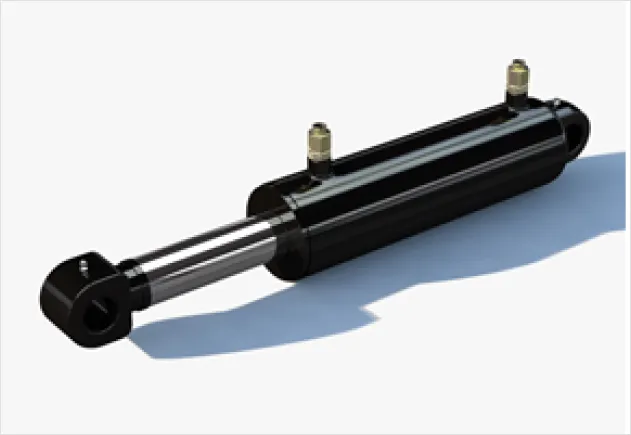
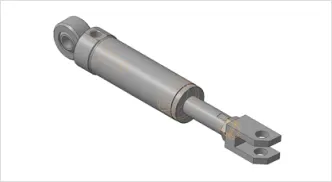
A hydraulic cylinder piston rod is a vital part of a hydraulic cylinder that protrudes from the barrel and attaches to the piston inside the cylinder.
The piston rod and piston work together to convert energy from combustion or fluid pressure into mechanical energy.
Hydraulic cylinder piston rods are often made of medium carbon steel. The medium carbon steel used as the raw material for the induction hardened rod.
Hydraulic Cylinder Piston Rods - S43Cr, 15B29, 41B30
1. Pinion - EN353, 20MnCr5
2. Rocker arm - SCM420H
3. UJ Cross - 16MnCr5
4. Propeller Shaft - ST52-3
6. Steering Shaft - S35C